


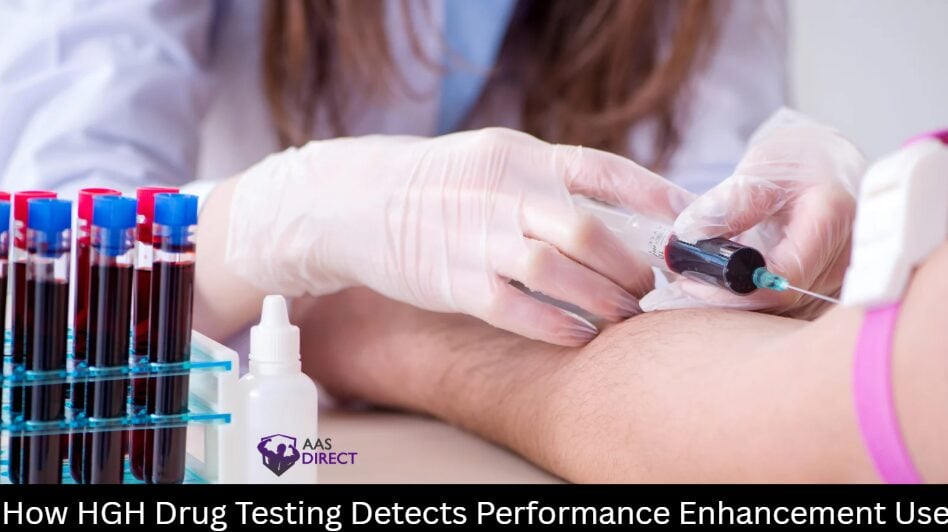
HGH drug testing relies on two main strategies to catch performance enhancement use. The isoform differential test detects suppressed natural hormone production within 24 to 48 hours of use. The biomarker test tracks biological changes like elevated IGF-1 levels, which stay detectable for weeks. You can’t simply time your use to avoid both tests. Anti-doping agencies combine both methods, making evasion far harder than you’d expect.
How HGH Drug Testing Actually Works
A simple urine strip or clear “positive/negative” answer isn’t how HGH drug tests work, like most people think they do. Finding human growth hormone requires blood samples and two different methods that work together.
The first is isoform differential testing, which looks at isoform levels to see if synthetic HGH has stopped your body from making its own hormones.
The second method is biomarker ratio analysis, which looks at changes in your body that happen after HGH has left your body, such as IGF-1 and procollagen markers.
All of these methods work together to make performance improvement screening work under anti-doping laws. The test isn’t just for the drug itself; it’s also for what it does to your body, which makes avoidance a lot harder than most athletes think.

How the Isoform Test Detects Recent HGH Use
Your pituitary gland makes different kinds of GH naturally, but synthetic HGH can only make one kind. Isoform differential testing finds out how many of these different types are in your blood test sample. When you use manufactured HGH, your body’s natural isoforms of hormones drop. It makes an abnormal ratio that shows you used HGH from outside your body.
The most important limitation you need to know about is the detecting window limitation. As you can see, time is very important for this test because it works best within hours to a couple of days after being given. Anti-doping agencies don’t just rely on isoform testing because athletes who know this window might be able to steer clear of discovery.
Why the Biomarker Test Reveals Longer-Term Doping
The biomarker method looks at the changes that HGH causes in the body instead of the hormone itself, which is different from the isoform test’s small detection window. Synthetic HGH turns on endocrine signaling pathways that raise levels of IGF-1 and blood protein markers such as P-III-NP. These body reactions don’t go away as quickly as the hormone does.
That’s why biomarker-based detection is so good at finding doping that lasts a long time or happens more than once. It’s still possible to measure the effects of HGH after it leaves your body. Anti-doping officials can find those high marks days or even weeks later, which makes this a good way to test athletes when they are not competing.
How Long Is HGH Detectable in Drug Tests
The main thing that determines how long HGH can be found in your body is the measuring method. It only takes 24 to 48 hours after your last dose for recombinant protein identification through isoform tests to show up. Because of this, time is very important for getting away from a doping test.
Human growth hormone (HGH) use can sometimes show up in serum biomarkers like IGF-1 and P-III-NP for several weeks after the last dose. It’s harder to get around these markers because they show how your body reacts to the drug rather than the substance itself.
How noticeable high amounts are also depends on your hormone baseline. Anti-doping programs use both methods together because one discovery window doesn’t work for everyone.
Why HGH Drug Tests Catch Athletes Even With a Short Detection Window
Anti-doping agencies don’t just use a small testing window to catch athletes, even though HGH leaves the body quickly. Instead, doping control techniques use more than one method to fill in the blanks left by fast clearance.
Isoform differential testing looks at your blood soon after using HGH to find out if there are any strange differences between the synthetic and natural forms. After that window closes, biomarker-based identification starts to work. It measures IGF-1 and procollagen markers that stay high long after the hormone itself goes away.
It’s also harder to time drug administration around scheduled checks because your anti-doping body uses random, unannounced tests. These ways work together to make a system where performance-enhancing drugs don’t need to stay in your body for testing to work. Biological clues they leave behind often do the job instead.